Imagine this……You spend time, money and effort driving traffic to your website.But the majority of people who come onto your website may not be ready to purchase. Without gaining an opt in, these prospects will simply leave your website and possibly never return.
Email marketing is the backbone of your company and underpins every other type of marketing you do.
Having a prominent email opt in on your website is a great way to capture information from those visitors that are ready to buy from you, but also (and most importantly) from those that would otherwise have left your website without purchasing anything.If this happens, these people are lost opportunities at that point, but if you craft a well presented, compelling email opt in form, you may well be able to capture their interest to hear more about you, or act on an opt in offer. You then have their contact details and can work towards providing further valuable information, and lead towards a conversion.But growing your list is also much more than just capturing those visiting and leaving your website. It needs to be a consistent long term effort across every touch point prospects have with you and your business.Whether it’s a sign up form on your website or a dedicated squeeze page to capture leads, let’s take a look at 6 key steps to creating a top notch opt in form:
Create a killer headline
As with a newspaper headline, your objective here is to create a compelling headline that is either BENEFIT driven (by this I mean it focuses on the benefits the subscriber will receive) or hits on a specific problem or wish that the subscriber’s you would like to attract have. It should be kept short and sweet whilst grabbing the attention of the user.The examples below show the difference between these two headlines:Speaking directly to your target audience: Benefit driven:
Be open, honest and transparent
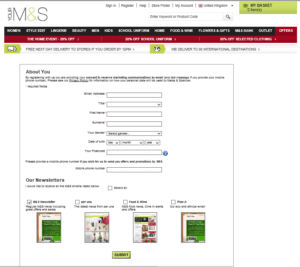
This form is the first impression of your business for many users, so it’s really important to start the relationship off in the right way and tell people exactly what they will receive and when, so that there are no nasty surprises when they start to receive your emails!By setting their expectations properly at the point of sign up, you will ensure that the people who register really want to receive your communications and are interested in what you offer. This will also help to ensure a low complaint rate (subscribers pressing the spam/junk button) and higher engagement (opens, clicks, conversions etc.) with your campaigns going forward.As can be seen in the example from M&S below, showing subscribers an example image / link to an example email that you’ve previously sent, that they can look at helps to illustrate exactly what your communications look like and the value provided.
Make it easy to use
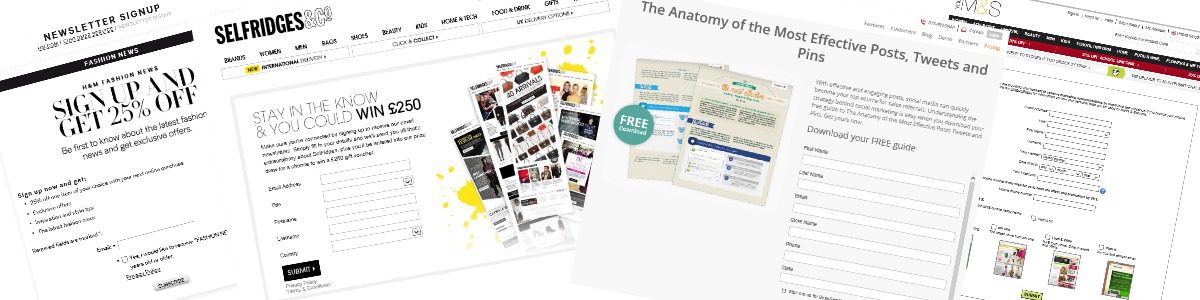
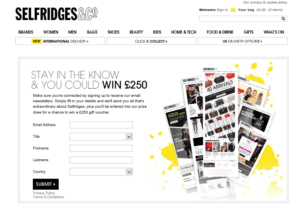
Ensure your sign up forms are not overly complicated, and are clean, easy to read and understand, as well as to complete. If you can, use systems that make the sign up form more intuitive (such as completing common email addresses, postal addresses from just postcodes etc.), this will also help people to complete the form quickly and easily.The example below from Selfridges shows a very easy to use, simple sign up form including drop down options, a benefit drive headline and images of previous emails sent to set expectations further.
Only collect the information you need
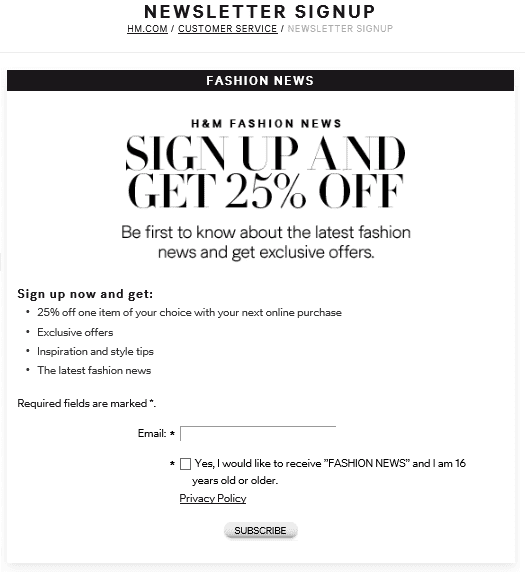
It is common marketing knowledge that the more steps you require someone to take to complete an action, the less likely they are to do so. The same holds true when it comes to prospects signing up for your email list – the more information you ask for, the less likely they are to complete the form and sign up.Collect only the information that you NEED on sign up, so email address, would of course be the minimum level of information needed to register them. However, by asking for items such as first name or what their interests are, you can ensure that you start to personalise your messages from the start of the relationship.On the flip side, the more fields you require to be completed, although this will reduce the number of sign ups you receive, it is likely that those that do will be even more qualified and interested in what you are offering.So consider carefully your business objectives, how you will want to personalise your communications going forward to ensure relevancy as well as the end conversion you are driving the sign up to, in order to decide what fields to collect on sign up and which could be collected later on in the relationship (such as during the on-boarding process; the initial sign up automated series of emails).In the example below from H&M they choose to only collect email address on sign up; this may be related to their opt in offer. Giving a discount on sign up means that any subscribers who go on to use this offer will provide more information during the purchase process.
Give something in return
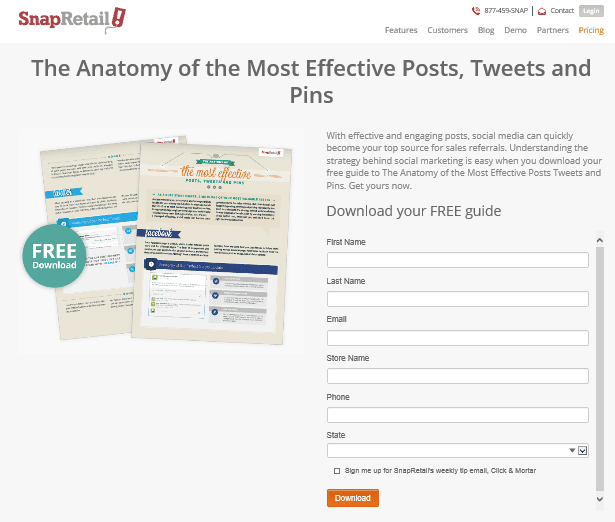
With so many email programmes out there to choose from, how can you encourage visitors that interact with your website, social media channels, shop front or other touch points, to register to receive YOUR emails?Sometimes called an opt in offer or lead magnet, adding an incentive gives an additional reason to the user to give you their email address (a valuable commodity) as well as helping to address and bolster the ‘what’s in it for me’ element of the decision to subscribe.The example below from SnapRetail shows a squeeze page offering a free guide as the incentive.Want more info about opt in offers? Download my free guide ’28 Incredibly Enticing Opt In Offers to Build Your Email List’ here >
Put it everywhere and make it prominent!
If no one sees your sign up form, how is your list going to grow?! Ensure you place it, and advertise it, everywhere that you have a touch point with prospects and customers including, first and foremost, your website.The key here is to capture the traffic you drive to your website through other marketing that you are doing; as I mentioned at the beginning of this post, email marketing underpins every other marketing effort you make. Want to know more?! Watch this short video >
Good creative executes a decision, it cannot rescue a weak one
The free CRM Priority Check shows you how well your programme makes those decisions in the first place, across six capabilities, in about five minutes.
Ready to take your email marketing to the next level?
If you want help to create a customer-centric, personalised, intelligent email marketing programme, get in touch with eFocus Marketing and discover how we can help you skyrocket your results.
Answer 22 questions to get your readiness score, your sharpest gap with three actions to take this week, and a to-do list for before, during and after the peak.
Free. A few minutes. Black Friday is on 27 November 2026, so the sooner you know, the more you can fix.
We use cookies on our website to give you the most relevant experience by remembering your preferences and repeat visits. By clicking “Accept”, you consent to the use of ALL the cookies. However you may visit Cookie Settings to provide a controlled consent.
This website uses cookies to improve your experience while you navigate through the website. Out of these cookies, the cookies that are categorised as necessary are stored on your browser as they are essential for the working of basic functionalities of the website. We also use third-party cookies that help us analyse and understand how you use this website. These cookies will be stored in your browser only with your consent. You also have the option to opt-out of these cookies. But opting out of some of these cookies may have an effect on your browsing experience.
Necessary cookies are absolutely essential for the website to function properly. These cookies ensure basic functionalities and security features of the website, anonymously.
Cookie
Duration
Description
cookielawinfo-checbox-analytics
11 months
This cookie is set by GDPR Cookie Consent plugin. The cookie is used to store the user consent for the cookies in the category "Analytics".
cookielawinfo-checbox-functional
11 months
The cookie is set by GDPR cookie consent to record the user consent for the cookies in the category "Functional".
cookielawinfo-checbox-others
11 months
This cookie is set by GDPR Cookie Consent plugin. The cookie is used to store the user consent for the cookies in the category "Other.
cookielawinfo-checkbox-necessary
11 months
This cookie is set by GDPR Cookie Consent plugin. The cookies is used to store the user consent for the cookies in the category "Necessary".
cookielawinfo-checkbox-performance
11 months
This cookie is set by GDPR Cookie Consent plugin. The cookie is used to store the user consent for the cookies in the category "Performance".
viewed_cookie_policy
11 months
The cookie is set by the GDPR Cookie Consent plugin and is used to store whether or not user has consented to the use of cookies. It does not store any personal data.
Functional cookies help to perform certain functionalities like sharing the content of the website on social media platforms, collect feedbacks, and other third-party features.
Performance cookies are used to understand and analyse the key performance indexes of the website which helps in delivering a better user experience for the visitors.
Analytical cookies are used to understand how visitors interact with the website. These cookies help provide information on metrics the number of visitors, bounce rate, traffic source, etc.
Advertisement cookies are used to provide visitors with relevant ads and marketing campaigns. These cookies track visitors across websites and collect information to provide customised ads.
 Imagine this……You spend time, money and effort driving traffic to your website.But the majority of people who come onto your website may not be ready to purchase. Without gaining an opt in, these prospects will simply leave your website and possibly never return.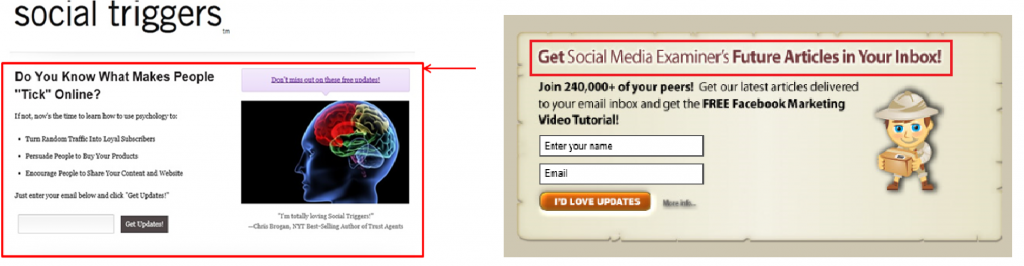
 Want more info about opt in offers? Download my free guide ’28 Incredibly Enticing Opt In Offers to Build Your Email List’ here >


